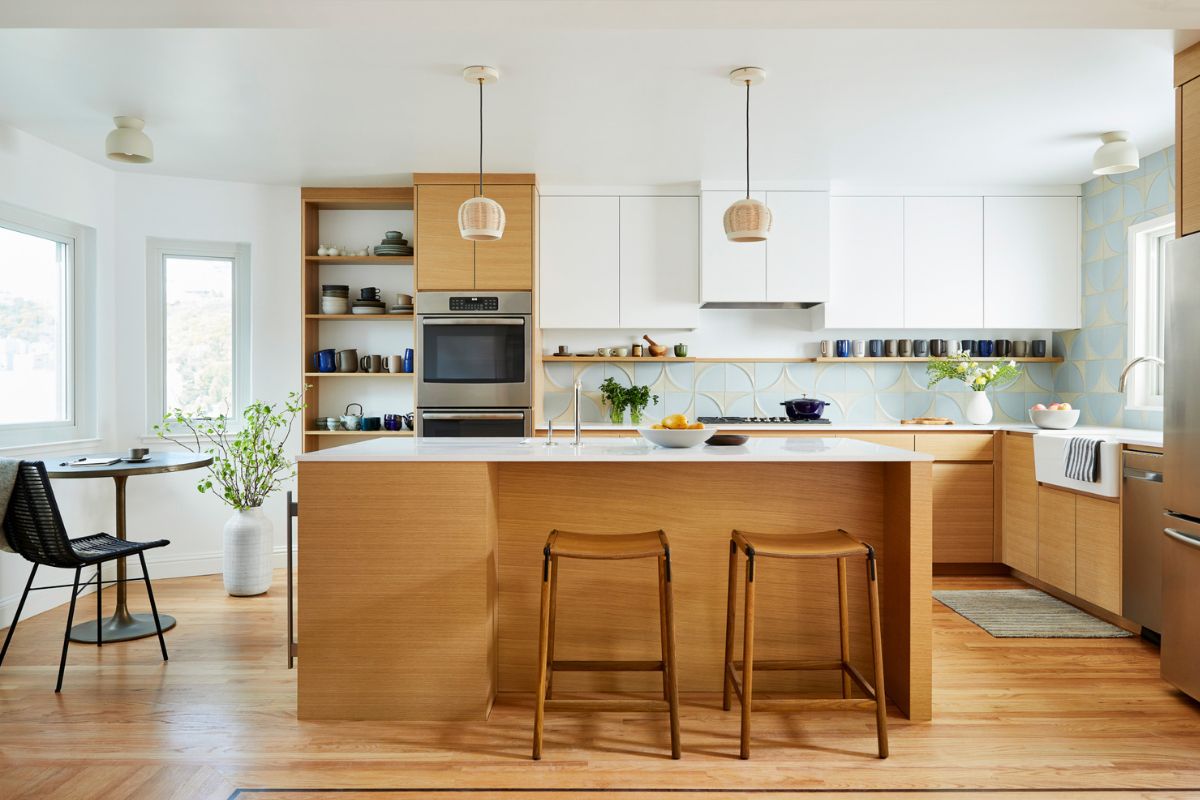
A contemporary style kitchen feels sleek, current, and built for real cooking. A large island wrapped in dramatic veined quartz, with the stone flowing down both sides in a waterfall edge, faces a wall of two-tone cabinets: matte charcoal below, warm wood veneer above. Linear pendants hang in a row over the island, an induction cooktop sits nearly flush with the counter, and a full-height slab backsplash catches the light. Everything looks clean, yet the room is full of texture and contrast.
Contemporary design describes what is current right now, so it evolves over time, unlike modern design, which refers to a specific mid-twentieth-century movement. In the kitchen, the current contemporary look combines functional minimalism with richer materials: clean lines and hidden storage, but also bold stone, mixed finishes, and sculptural lighting. The aim is a modern cooking space that works hard and feels personal rather than stark.
Key Takeaways
- Contemporary kitchens pair clean lines with bold materials and confident contrast.
- A large island often acts as prep station, dining spot, and social hub.
- Slab doors, integrated pulls, and panel-ready appliances keep surfaces calm.
- Two-tone cabinetry and mixed metals add depth without clutter.
- Layered lighting, including statement pendants, is part of the design.
- Smart storage and technology are built in rather than added on.
Contemporary vs. Modern vs. Transitional
These three terms are often mixed up, and understanding the difference makes design choices clearer.
Modern
Modern design refers to the early to mid-twentieth-century movement, with its honest materials, flat surfaces, and functional forms. A modern kitchen often features warm wood slab cabinets, simple geometric shapes, and organic accents.
Contemporary
Contemporary design follows current ideas, borrowing freely from modern, minimalist, and industrial influences. Right now, that means large-format stone, matte finishes, fluted or reeded details, and a mix of warm and cool tones.
Transitional
Transitional design blends traditional details, such as Shaker doors and classic hardware, with clean modern lines. A contemporary kitchen goes further toward simplicity, usually avoiding decorative trim and raised panels entirely.
Planning a Functional Layout
Functional minimalism starts with how the kitchen works. A clear layout makes every surface useful.
Work Zones and the Triangle
The classic work triangle connects sink, cooktop, and refrigerator, with each leg ideally between 4 and 9 feet. Contemporary kitchens often expand this into zones: prep, cooking, cleanup, storage, and a coffee or breakfast station. Place the dishwasher next to the sink and the trash pull-out within one step of the prep area.
The Island as Hub
An island in a contemporary kitchen often holds a prep sink or cooktop, deep drawers, and seating along one side. Allow 42 inches of walkway around it for one cook and about 48 inches for two. Plan 24 inches of width per stool and 12 to 15 inches of knee space under the overhang.
Open-Plan Integration
Contemporary kitchens frequently open onto living and dining spaces. Choose cabinet finishes and lighting that relate to the adjoining rooms, and position the cooktop where its ventilation can work well. A quiet, well-ducted hood is especially valuable in an open plan.
Cabinets and Hardware
Cabinetry sets the overall look, and contemporary kitchens favor simple doors with rich finishes.
Door Styles
Flat slab doors are the foundation of the style. Fluted or reeded panels on the island add texture, while thin-frame glass doors on a single upper cabinet can display a few glasses. Avoid raised panels and decorative trim, which belong to more traditional looks.
Two-Tone Schemes
Pairing two cabinet colors adds depth. Popular combinations include matte black lowers with natural oak uppers, deep navy island with warm white perimeter, and sage green with light walnut. Keep the darker tone low and the lighter tone high so the room does not feel top-heavy.
Pulls and Integrated Handles
Long edge pulls, recessed channel handles, and push-to-open hardware keep lines clean. Brushed brass, matte black, and brushed stainless all suit the style. Mixing two metals is fine if each appears at least twice, such as black pulls with a brass faucet and brass pendants.
Countertops and Backsplashes
Surfaces are where a contemporary kitchen can make its boldest statement.
Countertop Materials
Quartz is popular for its durability and low maintenance, with designs that range from solid white to dramatic veining. Porcelain and sintered stone slabs resist heat, scratches, and UV light, which makes them good for sunny rooms. Natural quartzite offers real stone character and is harder than marble, though it still needs sealing.
Waterfall Edges and Thin Profiles
A waterfall edge carries the countertop material down the sides of the island, creating a sculptural block. Thin countertop profiles, around 3/4 inch, look sleek and current, while a thicker mitered edge feels more substantial.
Backsplash Choices
A full-height slab backsplash in the same material as the counter is one of the defining contemporary looks. For tile, consider vertical stacked rectangles, large-format porcelain, or textured zellige-style tile in a single color. A small floating shelf in the same stone can hold oils or a plant without breaking the clean line.
Flooring Choices
Contemporary kitchen floors are durable, easy to clean, and usually low in pattern so the cabinets and stone take the spotlight.
Large-Format Porcelain
Porcelain tiles in 24 by 24 inch or larger sizes, with narrow grout lines, create a calm surface that resists stains and water. Concrete-look and limestone-look finishes in warm gray or soft beige are popular, and a matte or textured finish improves grip.
Wood and Wood-Look Floors
Wide-plank engineered wood in light or mid-tone oak adds warmth, especially in open-plan homes where the floor continues into the living area. Luxury vinyl plank is a practical, water-resistant alternative for busy family kitchens and rentals.
Polished Concrete
Polished or sealed concrete suits loft-style and industrial-leaning contemporary kitchens. It is extremely durable, though hard underfoot, so a washable runner in front of the sink adds comfort.
Color and Contrast
Contemporary kitchens use color with confidence while keeping a calm base.
Neutral Foundations
White, warm gray, greige, and black provide a timeless base. Warm whites have replaced stark bright whites in many current kitchens because they feel softer with wood and brass.
Strategic Accent Colors
Deep green, navy, terracotta, and charcoal work well on an island or lower cabinets. A single colored element, such as an island or range wall, gives the kitchen personality without overwhelming it.
Texture as Color
Wood grain, honed stone, fluted panels, and matte finishes add interest even in a mostly neutral room. Combining two or three textures prevents a flat, sterile look. Fluted wood island panels paired with a smooth stone backsplash are a popular current combination.
Lighting the Contemporary Kitchen
Lighting in a contemporary kitchen is both practical and sculptural.
Ambient, Task, and Accent
Recessed downlights or slim linear ceiling lights provide ambient light. LED strips under upper cabinets light the counters, while strips inside glass cabinets or under the island toe-kick add accent and a soft night glow. Use dimmers on every layer.
Statement Pendants
A row of two or three pendants over the island, or one long linear fixture, defines the space. Globe pendants in opal glass, cylinders in black or brass, and minimalist linear bars all suit the style. Hang them so the bottoms sit 30 to 36 inches above the counter.
Maximizing Natural Light
Keep window walls clear of upper cabinets where possible and use simple roller shades or woven wood shades. A glossy or light-colored backsplash reflects daylight deeper into the room.
Technology and Smart Storage
Contemporary kitchens integrate technology so it supports cooking without adding visual clutter.
Appliances
Induction cooktops heat quickly and precisely, stay cooler to the touch, and are easy to clean. Panel-ready refrigerators and dishwashers blend into cabinetry. Steam ovens, speed ovens, and warming drawers can be stacked in tall units to free counter space.
Hidden Features
Useful built-in features include:
- Pop-up or drawer-mounted charging outlets for phones and small devices
- Touchless or foot-activated faucets for messy hands
- Motion-sensor lighting inside pantries and deep drawers
- Pull-out pantry units and corner carousels to use awkward spaces
Energy and Water Efficiency
Energy-efficient appliances, LED lighting, and low-flow faucets reduce running costs. Induction is also more energy efficient than gas or traditional electric cooktops because heat goes directly into the pan.
Small Kitchens and Budget Updates
Contemporary style adapts well to small spaces and modest budgets.
Small-Space Ideas
In a galley or compact kitchen, run cabinets to the ceiling, use a slim peninsula instead of an island, and choose a single light cabinet color so the room feels larger. A narrow rolling cart can act as extra prep space and tuck away when not needed.
Updates That Make the Biggest Difference
Replacing dated hardware with long, slim pulls, painting cabinet doors in a matte two-tone scheme, and swapping old pendants for simple contemporary fixtures can refresh a kitchen without a full remodel. A new faucet in brushed brass or matte black is another quick, high-impact change.
Common Mistakes
Contemporary kitchens can go wrong when trends take over function.
- Using too many bold finishes at once, so nothing stands out.
- Choosing high-gloss everything, which shows fingerprints and glare.
- Undersizing the island walkways in pursuit of a larger island.
- Forgetting warm elements, leaving the room cold and clinical.
Conclusion
A contemporary style kitchen brings together functional minimalism and expressive materials. Clean slab cabinets, a hardworking island, bold stone surfaces, layered lighting, and built-in technology create a modern cooking space that is efficient and inviting.
Plan the layout around how the household cooks, choose one or two statement materials, and balance them with warm wood and soft light. The result is a kitchen that feels current today and remains comfortable to use for years.
Frequently Asked Questions
More Contemporary Style Decor
- Contemporary Style: The Definitive Guide
- Contemporary Style Bedroom: A Blend of Elegance and Simplicity
- Contemporary Style Living Room: Sleek and Sophisticated Design
- Contemporary Style Bathroom: Innovative Design for Modern Comfort
- Contemporary Style Dining Room: Embracing Trends for Stylish Dining Experiences
- Contemporary Style Entryway: Stylish Introduction to Modern Living